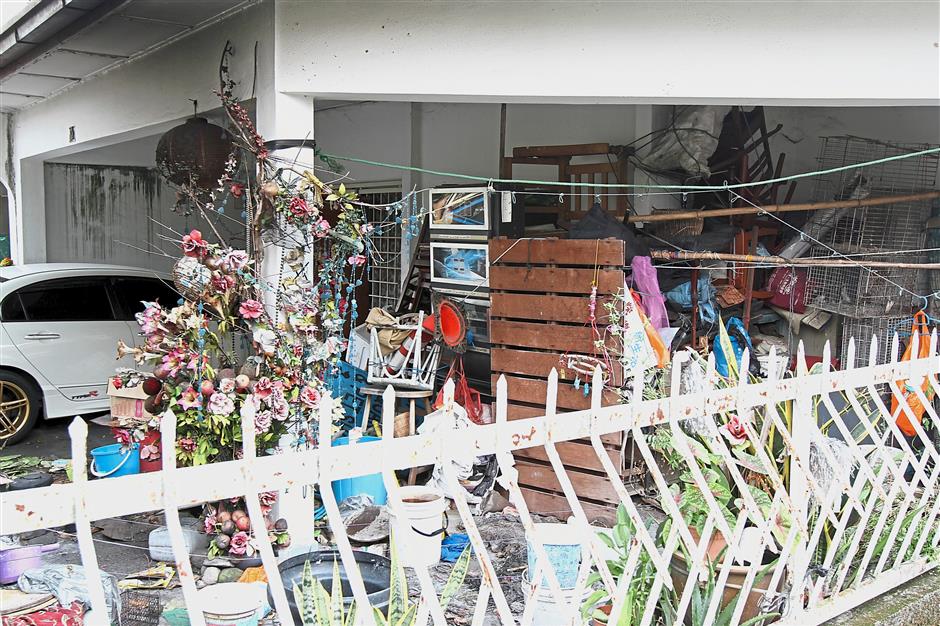
MBPJ had cleared junk from this house in Petaling Jaya some years ago but the hoarded items are building up again. — LOW BOON TAT/The Star
THE habit of hoarding is a problem that not only affects the hoarders themselves but also their neighbours as such houses become a fire and health hazard.
The issue of hoarding is a universal problem and it can happen to both young and old, rich and poor.
StarMetro delves into the case of a hoarder and finds out from medical professionals and relevant experts about how the community can play a role in helping such people.
A spacious double-storey corner lot property in Petaling Jaya belongs to a hoarder in her early 60s.
Empty detergent bottles, cupboards, stuffed toys and heaps of disintegrated waste occupy nearly every inch of this house.
Her next-door neighbour, Andrea De Cruz said the owner used to collect and sell recyclables in the 1990s for extra income.
“Her recycling habit was not a problem to us in the past.
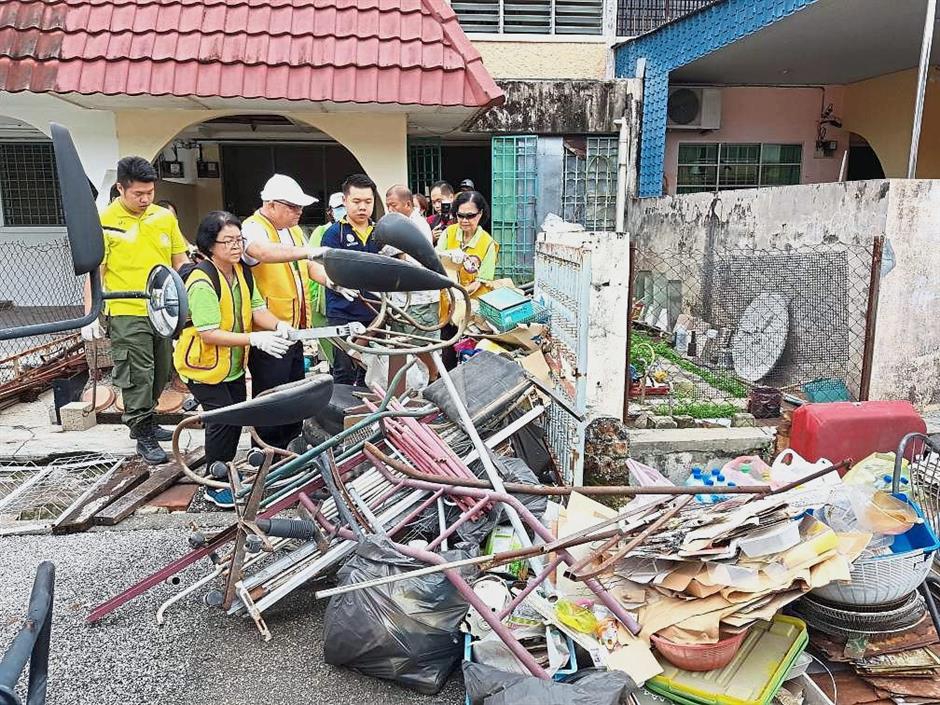
Dr Ng (wearing a cap) is seen here with his team helping to clear junk from a hoarder’s house in Ipoh with the owners approval. — filepic
““But the hoarding worsened over the years. It is no longer pleasant to live beside this house because it is now filled with garbage,” said De Cruz, adding that the heaps of rubbish could be a breeding ground for mosquitoes.
“I have experienced an increase in mosquitoes in recent years. Several months back, I spotted a wild cat coming from the house. When I gave chase, the animal ran into her house through the roof,” he said.
Another neighbour spotted the woman scavenging a neighbour’s rubbish bin at about 4am.
“She would open our bins, ransack our trash and take it home,” she said.
The woman had also been spotted roaming in the back alley and in the neighbourhood park scavenging for trash.
Who are they?
Universiti Malaya Geriatric Medicine Department Associate Professor Dr Tan Maw Pin said older people might hoard but there was no research to indicate that hoarders were always the elderly.
Among the elderly, she said, the hoarding behaviour sometimes stemmed from experiencing times of scarcity when they were younger.
“For example, if you had been through famine you would understand what it is like to be without food.
“Same goes for a lot of our elderly who had experienced hard times of war, they would always want to save up on food and things to provide for themselves in times of need,” she added.
Dr Tan said that while people could control their behaviour when they were younger, the habit might lead to hoarding as they became older and suffered from various illnesses, disabilities or injuries.
“Some hoard food which they will not eat, and when this goes bad, it emits a stench.
“Also, a hoarder could initially be recycling things for extra income but upon suffering from an illness, the situation spirals and turns into hoarding,” she said.
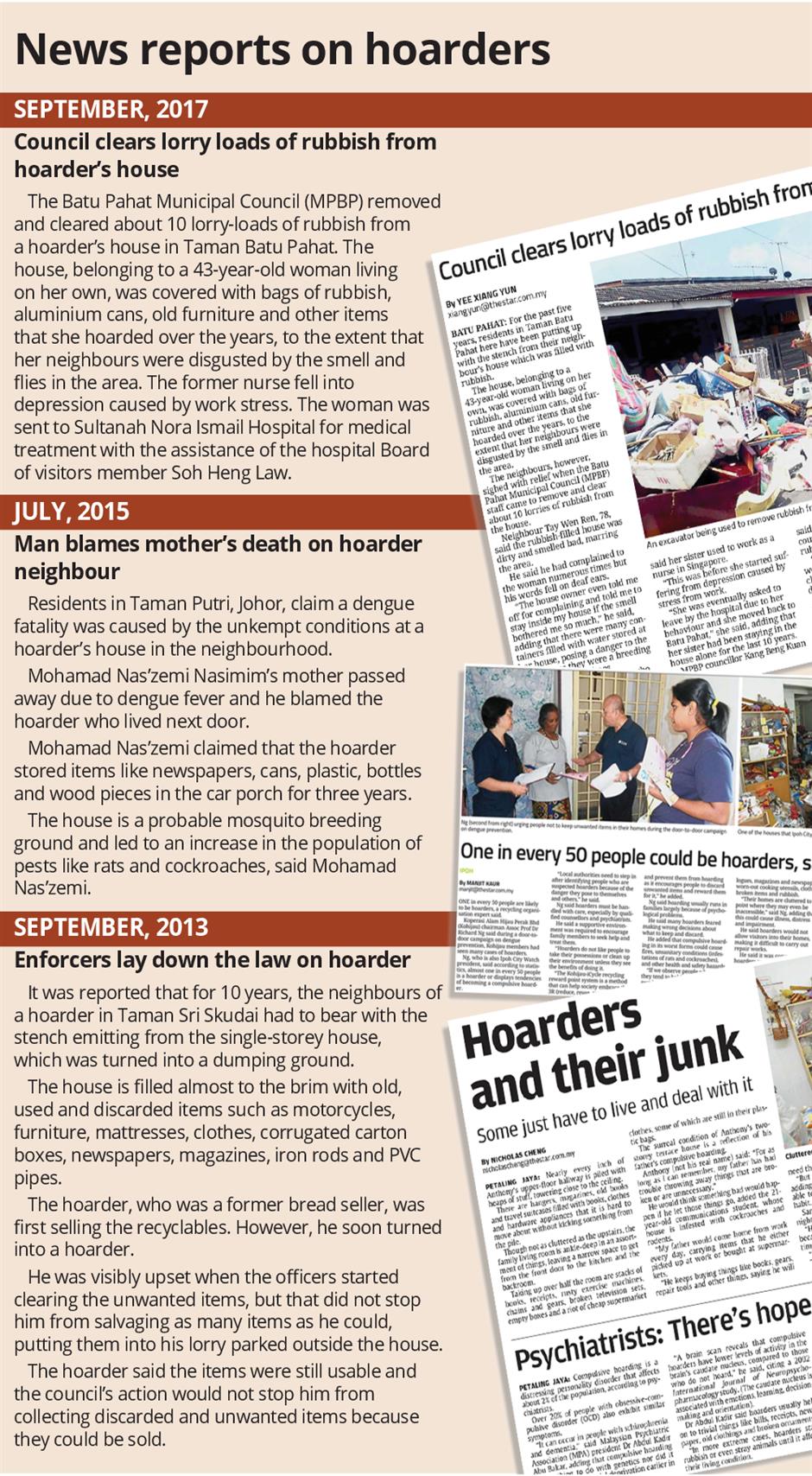
She said there had been instances of hoarders having been killed when the bulk of items in their house fell on them.
She cited a famous case in 1940 of two brothers Homer and Langley Collyer from New York, US, who were found dead side by side in their mansion filled with junk.
Based on a news report Homer turned blind and Langley started hoarding newspapers to enable the brother to catch up with the news once he regained his vision. They were believed to have been crushed to death by the junk.
She added that said the situation would turn into public nuisance when hoarders’ homes emitted a foul smell or attracted rodents and mosquitoes. It would then require the intervention of the local council.
Dr Tan said doctors often met the elderly with hoarding issues after they were admitted to the hospital due to a fall.
She said at times, decisions were made to send a hoarder to an old folk’s home once they were discharged.
“There have been cases when the council seals the house for cleaning purposes and the elderly person cannot return home,
“Family members will sometimes tell us that the elderly must not leave the hospital. They should be instead be sent to nursing homes.
“In some instances, sending them to the nursing centres may be the better solution because they cannot continue with the hoarding habit. However the person’s autonomy needs to be considered.” she emphasised.
Both men or women may be hoarders but in some cases due to cultural stereotype men may have more tendencies.
“Their mother or wife may be the one cleaning up the house all their lives. When they pass on and with no help, the men may not know how to keep the house tidy. This can lead to hoarding too,” said Dr Tan.
She suggested that neighbours could take turns to take food to elderly hoarders at their homes and help them with chores.
Possible treatment
Malaysia Mental Health Association deputy president Datuk Dr Andrew Mohanraj said hoarding could be an effect of a disorder.
“A person may be suffering from delusion due to schizophrenia. When you provide them with holistic treatment followed by rehabilitation, they can become well,” said Dr Andrew, who is a qualified consultant psychologist.
He said the issue of hoarding became a problem only when the person displayed characters of impairment to themselves and the surrounding.
Hoarding can be seen as a feature of conditions such as obsessive compulsive disorder, schizophrenia and certain types of personality disorder.
“Some have obsessive compulsive disorder (OCD) and they may be at the either end of the spectrum. They may be extra clean or become hoarders. Sometimes they may feel safe when they hoard items.
“There are those who hoard food containers, pots and pans. This is not a problem if they are not causing nuisance to others,” he said, adding that hoarders and those with OCD could be helped with intervention.
He said there were also those who hoard all types of currencies in large amounts in their homes.
“They just feel safe looking at all the money. They are also hoarders,” he said, calling for the authorities to take an understanding view when helping hoarders.
“Do not be judgmental. The hoarder may be suffering from mental illness, help them address their mental illness first before helping them clear their space,” he said, adding that hoarders would need continuous rehabilitation after treatment.
Understand hoarders
Non-governmental recycling organisation Koperasi Alam Hijau Perak Bhd (Kohijau) chairman Dr Richard Ng said residents and local councils should take the soft and amicable approach when dealing with hoarders as they normally perceived trash as valuables.
“They are not in the same state of mind as an average person. They may be holding on to things that has no value but we must respect them and help them,” said Dr Ng, who is actively involved in recycling and promoting gotong-royong events in Perak.
He had dealt with several hoarders in his years of experience.
Based on his experience, hoarders could be helped with proper psychological help as well as family and neighbours support.
He also urged local authorities and non-governmental organisations to reach out to hoarders.
“When the affected person says something is important in the clutter of mess, we do not take it away. It is clearly invaluable to us, but it is precious to the hoarder.
“We have to do it slowly,” he said.
Dr Ng encouraged people with the right knowledge to approach the hoarder instead of bulldozing into their private space.
In most instances, he said the hoarder might be living in isolation and had little ties with their family.
“From our experience, the family members may have had a fallout with the hoarder,” he said, adding that their family members might have moved out due to constant arguments centred around the trash.
“In my experience, these hoarders are harmless people. They may suffer from depression and discrimination from their families. They may also have inferiority complex that prevents them from reaching out to the public for help,” he said.
 Dr. Andrew Mohanraj