With no clear end in sight to home-based teaching and learning (PdPR), students from low-income (B40) families need our help now more than ever.
The International Association for the Evaluation of Educational Achievement (IEA), which runs the Trends in International Mathematics and Science Study (TIMSS) 2019, recently found that many students around the world lacked suitable resources to study at home as hundreds of thousands of schools have closed (see infobox).
“Lower achievement levels were seen in students without a computer, and even more so, a study desk, with lower performing students more adversely affected.
“It is therefore important to focus on a complete set of resources at home, including a desk and quiet place to study, and for schools and governments to develop especially targeted initiatives to provide vulnerable groups with extra support, ” IEA executive director Dr Dirk Hastedt said.
The effectiveness and outcome of the ongoing (PdPR) are highly dependent on the study environment, Malaysian Mental Health Association president and consultant psychiatrist Professor Datuk Dr Andrew Mohanraj opined.
Sadly, many of our B40 students live in exceptionally cramped spaces where a conducive learning environment is a luxury.
“Children from disadvantaged households have to make do with smaller, uncomfortable learning spaces and noisy surroundings.
“Coupled with unreliable Internet connectivity, these factors can lead to poor academic performance and can have a negative effect on the mental and physical health.”
Agreeing, Sunway Education Group Student LIFE director Lee Siok Ping said not having a suitable learning space increases stress and anxiety which affect both the student’s ability to focus, to absorb information and to stay engaged during virtual classes.
“This, in turn, might lead to long-term effects on the student’s overall health and learning, ” she said.
The home environment – irrespective of the size of the study space – must support learning activities, said Dr Andrew.This is especially so with Education Minister Datuk Dr Radzi Jidin announcing last Sunday that national schools will undergo “at least 25 days” of PdPR until the mid-semester school holidays, which starts on July 16.
After that, PdPR will continue until the National Security Council decides otherwise.
“Poor children are likely to achieve lower academic performance because they don’t have a suitable learning space at home.
“To make matters worse, their parents are not able to support their children’s learning as they are too busy making ends meet, ” said Dr Andrew.

We can help
Taylor’s University School of Architecture, Building and Design lecturer Dr Camelia May Li Kusumo said one of the most important aspects of a learning space at home is the “acknowledgement” of a dedicated study area.
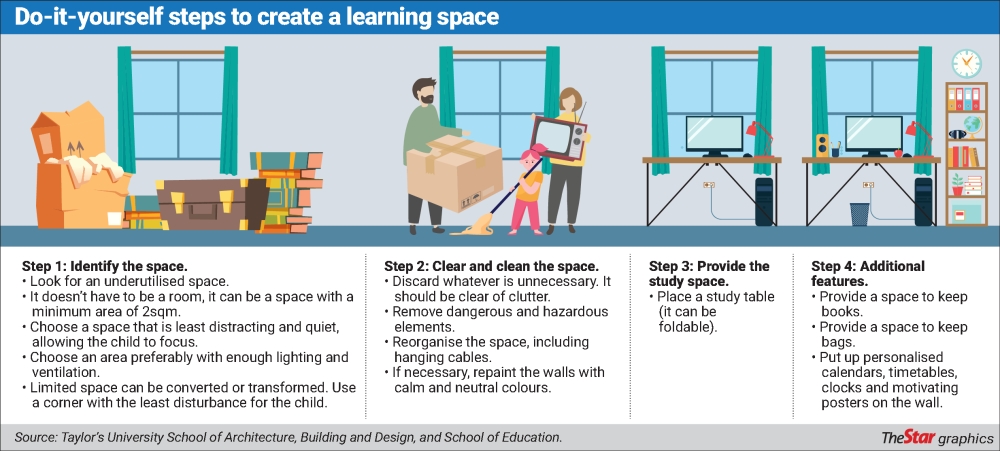
“Acknowledging the existence of a proper space – both the physical and intangible aspects – encourages children to study and parents to support them, ” she said, adding that a learning space can be created even in a small home and with the use of old, broken or recycled materials to save cost.
“Broken furniture can be repurposed into desks, shelves and chairs, ” she said.
In 2018, Camelia’s School of Architecture, Building and Design students created in-house learning spaces for 12 underprivileged families at the Lembah Subang 2 People’s Housing Project (PPR).
Plans are underway to expand the project to low-cost housing units across the Klang Valley.
Coming from a B40 background herself, Academy of Professors Malaysia Education and Human Development Cluster head Prof Dr Rosna Awang-Hashim understands the need for learning spaces all too well.
Describing it as crucial, she said a dedicated learning space is vital because the environment can influence the quality of learning.
Calling on state assemblymen and community leaders to do more, she said local libraries and community halls in residential areas can become a well-stimulated learning space to foster creativity and minimise distractions.
“Space can affect emotion and the role of emotion in learning can never be underestimated.
“For example, it’s not recommended to create a learning space next to the kitchen as it’s noisy and distracting, ” she added.
Sunway’s Lee said people can come together to create suitable learning space for B40 children in their own community areas.
Education institutions, as well, should allow B40 students access their campus classrooms as a learning space.
“A learning space is based on individual needs and preference; it can be anywhere.
“The community can educate these children by providing guidelines to help them create their own learning space within their means with the available resources.
“Communities can also work with families to understand the importance of having dedicated learning spaces within the home, ” she said.
Invest in children
United Nations Children’s Fund (Unicef) Malaysia education specialist Azlina Kamal said children who receive assistance in their early years are more successful in school.
Home resources such as books, a private room and Internet connection, she said, can influence children’s learning motivation and achievement.
Early investment is especially necessary for marginalised and vulnerable children living in minority or indigenous communities, those with disabilities and those with special education needs, she said.
“We must provide a social protection system that mitigates the effects of poverty on families, strengthens families in their child care role, and enhances access to basic services for the marginalised.
“Since many at-risk children live outside family care, the system must be responsive to this vulnerable group, as well as to children facing abuse or discrimination at home, ” she said, adding that the pandemic was a clarion call for all stakeholders to accelerate the nation’s child protection efforts.
Full Article: https://www.thestar.com.my/news/education/2021/06/13/give-them-some-space
 Dr. Andrew Mohanraj