The Invisible Illness
Often undetected or dismissed and left untreated, mental health issues at the workplace can lead to physical health and social issues as well as impact business bottom lines By Lim Hong Meng
With rising work stress and the uptrend in mental health conditions, supporting employee mental wellness at the workplace has become increasingly important. According to the 2019 National Health and Morbidity Survey, one in three Malaysians struggles with a mental health condition at any one time in their lives with an average of 29 percent of workers suffering from poor mental health. Studies have long shown a correlation between mental, emotional, and physical health.
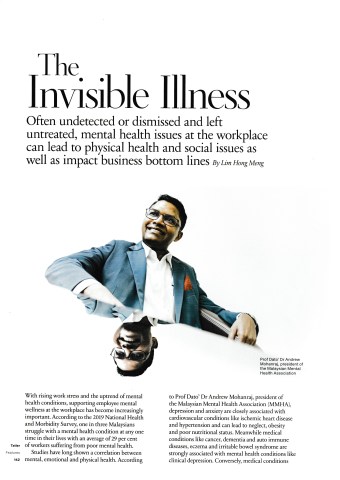
According Prof Dato’ Dr. Andrew Mohanraj, president of the Malaysian Mental Health Association to Prof Dato’ Dr. Andrew Mohanraj, president of the Malaysian Mental Health Association (MMHA), depression and anxiety are closely associated with cardiovascular conditions like ischemic heart disease and hypertension and can lead to neglect, obesity, and poor nutritional status. Meanwhile, medical conditions like cancer, dementia and autoimmune diseases, eczema, and irritable bowel syndrome are strongly associated with mental health conditions like clinical depression.
Conversely, medical conditions like hyperthyroidism, hypothyroidism, metabolic and hormonal disorders, electrolyte derangements and chronic use of certain medications like steroids can mimic psychiatric disorders like anxiety and depression. Without effective support, mental disorders and other mental health conditions can affect a person’s confidence and identity at work, capacity to work productively and ease with which to retain or gain work.
This negatively impacts the economic output of corporations. A white paper released by Relate Malaysia revealed that the cost of mental health issues at the workplace was conservatively estimated to be RM14.46 billion or 1 per cent of GDP. This figure is projected to reach RM100 billion by the year 2030 if the issue in working adults is not addressed.

‘IMAGES COURTESY OF MA BHD (PENELOPE GAN), OMNICOM MEDIA GROUP (EILEEN 001), IMRAN SULAIMAN (ANDREW MOHANRAJ)
PROVIDING SUPPORT
“Nurturing a culture of transparency and support for health and well-being issues is the first step to combating the negative associations of mental health problems in the workplace,” says Mohanraj.
“Employees need to feel safe to be open about their health and well-being, without fear of disciplinary action. It is important to build trust between leaders and staff. Boosting morale and resilience at the workplace positively impacts productivity.” He advised organisations and companies to play their part in protecting and promoting mental health at work through appropriate training that empowers line managers to detect mental health issues at the workplace as well as offer appropriate support to those affected so they may participate fully and equitably in work.
He added that training should also encompass having workplace policies that do not discriminate against workers with mental health issues but rather, support them. High-performing staff too are susceptible to burnout and companies should have support pathways in place for such individuals as well. For smaller companies that are unable to enlist external training or support, improving mental health literacy among the workforce and practising non-discriminatory policies in supporting workers who seek mental health treatment could be the first step towards creating a humane and inclusive work environment.
BENEFITS OF A MENTAL HEALTH PROGRAMME
Among the advocates of employee mental wellness that have employee wellness programmes in place include Omnicom Media Group (OMG) and AIA Bhd. Both reported positive outcomes. OMG saw its highest growth in the last two years with increased
Penelope Gan, chief human resources officer of AIA Bhd employee positivity and improved engagement. There was no drop in productivity despite the challenges posed by the Covid-19 pandemic. Their employees showed commitment to the company and continued to deliver during their most challenging years in the decade. According to Eileen Ooi, chief executive officer of Omnicom Media Group Malaysia, the support they received from their clients, who understood their cause and respected their employees’ needs, was a significant achievement.
Their example has led leaders in the industry to join in on the conversation to break the taboo around mental health discussions, which, in Ooi’s view, is their most important achievement. AIA employees too thrived under the company’s WorkWell with AIA proposition, an offering under its Total Corporation Solution business. A mental health programme is part of this WorkWell proposition.
Through this programme, they saw promising trends of improvement, with employees reporting a 43 per cent average reduction in depression, anxiety and stress levels.
Additionally, employees who engaged with a certified mental health professional through the ThoughtFull digital coaching support app—which offered employees convenient access to one-on-one confidential coaching with certified mental wellness professionals—reported positive changes in their outlook and behaviour. According to Penelope Gan, chief human resources
 Dr. Andrew Mohanraj